THE HENRIETTE JOURNAL
On-Page SEO: How to Make Existing Pages Work Harder
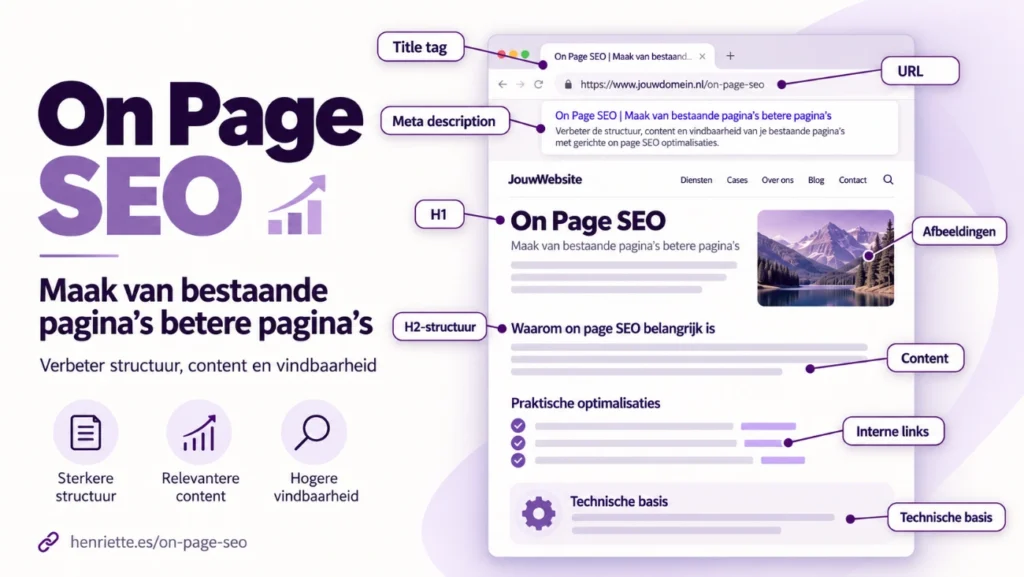
On-Page SEO is often the fastest way to get more value from the pages you already have. Your website does not always need more pages, more blog posts or more content to improve its visibility in Google.
Very often, the opportunity is already there.
An existing service page, category page or blog post may contain valuable information but still underperform because the structure is unclear, the search intent is not fully addressed or important SEO elements do not work together properly.
On-page SEO focuses on exactly those elements.
It improves the content and structure of individual pages so visitors immediately understand what the page offers and search engines receive stronger signals about its subject and relevance.
Good on-page optimization is not about repeating a keyword as often as possible. It combines search intent, content, headings, title tags, meta descriptions, internal links, images and technical page elements into one clear structure.
The goal is simple: create a page that is easier to understand, more useful to visitors and better positioned to compete in organic search.
What is on-page SEO?
On-page SEO refers to the improvements made directly to pages on your own website.
Unlike off-page SEO, such as building contextual backlinks, most on-page elements remain under your direct control.
These elements include the text on a page, headings, SEO titles, meta descriptions, URLs, images, internal links and the way the information is structured.
Effective on-page SEO does not treat these elements as separate tasks. The real strength lies in the way they support each other.
The title introduces the subject. The H1 confirms the main topic. The introduction quickly explains the purpose of the page, while the H2 and H3 headings guide the reader through relevant subtopics.
| On-page SEO element | What to review | Main purpose |
|---|---|---|
| Search intent | What does the visitor actually want to know or do? | Match the page more closely to the search query |
| Title tag | Main topic, keyword relevance and clarity | Create a stronger search result |
| Meta description | Clear summary and reason to visit the page | Improve relevance and click appeal |
| H1 | Main message of the page | Make the subject immediately clear |
| H2 and H3 | Logical subtopics | Improve readability and structure |
| Content | Quality, relevance, completeness and readability | Answer the visitor’s question properly |
| Internal links | Connections between relevant pages | Strengthen navigation and topical relationships |
| Images | Relevance, filename, size and alt text | Support usability and context |
Why improving existing pages is often the smarter SEO move
Many websites continue publishing new content while important existing pages receive very little attention.
That is not always the most effective SEO strategy.
A page that is already indexed by Google, receives internal links and perhaps already ranks on page two or three has a foundation to build on.
Instead of starting from zero, you improve the signals that are already there.
During an on-page SEO audit, I often look for issues such as:
- keywords for which the page already has visibility;
- important subtopics that are missing;
- weak or overly generic H1 headings;
- unclear H2 and H3 structure;
- title tags that do not reflect the search intent;
- missing or ineffective meta descriptions;
- insufficient internal linking;
- overlapping or duplicate content;
- sections that add little value;
- outdated information;
- images without useful filenames or alt text.
The aim is not simply to make a page longer.
The aim is to give the page a clearer purpose and stronger topical focus.
1. Search intent comes before keywords
Before changing headings or adding keywords, first establish why someone searches for the topic.
A search for on-page SEO, for example, has a different intent from on-page SEO services.
The first search is primarily informational. The second has a much stronger commercial intent.
A page that tries to target both without a clear structure often becomes unfocused.
Strong SEO content optimization therefore starts with questions such as:
- What is the primary search query for this page?
- What does the visitor expect to find immediately?
- Which supporting questions need an answer?
- Is the page informational, commercial or transactional?
- Does the existing content still match its original purpose?
Only after answering those questions should you start refining keywords, headings and metadata.
2. A strong title tag starts with clarity
The title tag is one of the most important on-page SEO elements.
It should explain the subject of the page clearly while giving searchers a reason to choose your result.
Compare these examples:
SEO Services | Henriette
and:
On-Page SEO Services for Stronger Existing Pages | Henriette
The second version immediately explains what the service is about.
Avoid stuffing several keyword variations into one title, such as:
SEO Expert, SEO Optimization, SEO Company, Website SEO, Google SEO Services
This does not create a stronger title. It usually makes the result less readable and less convincing.
A good SEO title combines a main topic with a clear reason to visit the page.
3. Treat the meta description as a short sales pitch
The meta description gives you a small amount of space to explain why a page is relevant.
Do not treat it as storage space for extra keywords.
Instead, use it to summarize the page and create interest.
For example:
Improve existing pages with smarter on-page SEO. Optimize content, headings, metadata and internal links to create stronger pages for users and search engines.
Clear, relevant and completely aligned with the page.
4. Build a logical H1, H2 and H3 structure
Many SEO problems begin with poor page structure.
A page may contain several large headings without a clear hierarchy, or different subjects may be mixed together without a logical order.
This creates unnecessary friction for visitors and makes the topic harder to interpret.
A simple heading hierarchy usually works best:
- H1: the main subject of the page;
- H2: important sections or subtopics;
- H3: further detail within an H2 section.
Your headings do not all need to repeat the exact same keyword.
Natural variations create stronger content.
For a page about on-page SEO, related terms may include:
- website SEO optimization;
- SEO content optimization;
- WordPress SEO;
- website optimization;
- internal linking;
- search intent;
- SEO copywriting;
- improve website visibility;
- SEO page structure;
- content optimization.
This gives search engines much more context than repeating one exact phrase throughout the page.
5. Improve the content, not just the keyword count
A page does not become better simply because the focus keyword appears more often.
Strong SEO content answers the questions behind the keyword.
A page about WordPress SEO, for example, should probably cover more than a definition. Visitors may also expect information about headings, plugins, content structure, metadata, internal links, images and website performance.
If those relevant subtopics are missing, the page may feel thin even when the main keyword appears several times.
That is why a proper content review focuses on elements such as:
- the main question of the page;
- important supporting topics;
- missing information;
- unnecessary repetition;
- outdated sections;
- logical reading order;
- clarity and readability;
- commercial relevance;
- calls to action.
Good SEO copywriting brings these elements together without making the text sound as if it was written for a search engine.
6. Internal linking gives your website structure
Internal links connect related pages and help visitors move naturally through a website.
They are also one of the most underused areas of on-page SEO.
A blog about website optimization should logically connect to a relevant on-page SEO service. A page about improving content may link to a copywriting service, while a broader commercial page may lead visitors to an overview of your SEO services.
The anchor text should describe what someone will find after clicking.
An anchor such as on-page SEO services gives much more context than a generic phrase such as click here.
A well-planned internal linking structure helps to:
- connect related subjects;
- guide visitors to useful pages;
- reduce orphan pages;
- give important pages more internal authority;
- build stronger topical relationships across the website.
7. Do not forget image SEO
Images do more than make a page look better.
They support the content and improve the reading experience.
Choose images that actually add something to the page and place them close to relevant text.
Each image should also have:
- a clear filename;
- descriptive alt text;
- appropriate dimensions;
- sensible compression;
- a relevant position within the page.
A filename such as IMG_847293.jpg provides no useful context.
A filename such as on-page-seo-website-optimization.webp is far more descriptive.
The same principle applies to alt text.
Do not fill it with keywords. Describe the image clearly and naturally.
8. The technical foundation still matters
On-page SEO mainly focuses on content, relevance and page structure, but a poor technical foundation may still hold a strong page back.
Important checks include:
- whether the page is indexable;
- whether the URL is short and logical;
- whether internal links work correctly;
- whether images are unnecessarily large;
- whether the mobile layout works properly;
- whether important content is visible and accessible;
- whether redirects and canonical tags make sense.
Large technical problems sometimes require a developer or a dedicated technical SEO audit.
For normal page optimization, the main priority is ensuring that the technical setup does not prevent the content from performing properly.
On-page SEO for WordPress websites
WordPress makes many on-page SEO improvements relatively straightforward.
SEO plugins such as Yoast SEO and similar tools provide access to title tags, meta descriptions and other useful page settings.
Within WordPress, you may also improve:
- H1, H2 and H3 headings;
- page content;
- internal links;
- image alt text;
- URL slugs;
- categories;
- calls to action;
- page layout.
This means that a focused WordPress SEO optimization project often produces a much stronger page without rebuilding the entire website.
On-page SEO and backlinks work better together
A strong SEO strategy does not stop with the content on your own website.
| On-page SEO | Off-page SEO |
|---|---|
| Improve existing content | Build contextual backlinks |
| Optimize H1 and H2 headings | Gain external authority |
| Improve titles and meta descriptions | Develop a relevant backlink profile |
| Strengthen internal links | Point external links to priority pages |
| Align content with search intent | Support authority around important topics |
A strong backlink pointing to a weak landing page does not reach its full potential.
At the same time, a perfectly optimized page in a competitive market may still need additional authority from external websites.
That is why I prefer to look at both sides of SEO.
First, make sure the page itself is strong. Then decide whether relevant backlinks may give it additional support.
AI makes on-page SEO faster, not automatically better
AI has created many useful opportunities for SEO and content optimization.
It helps with research, content structure, semantic keyword ideas, rewriting unclear sections and processing large amounts of information efficiently.
But AI still needs direction.
A tool does not automatically understand your customer, commercial objectives, competitive market or website history.
Without strong input, AI-generated content quickly becomes generic.
My own workflow therefore combines AI with manual SEO analysis and personal review.
AI speeds up the process. SEO strategy determines the direction.
On-page SEO checklist for existing pages
Want to review one of your own pages first? Start with this checklist.
| SEO check | Status |
|---|---|
| Does the page have one clear primary topic? | □ |
| Does the content match the search intent? | □ |
| Is the title tag unique and descriptive? | □ |
| Does the page have a relevant meta description? | □ |
| Is there one clear H1? | □ |
| Do the H2 headings cover logical subtopics? | □ |
| Is important information missing? | □ |
| Are relevant internal links included? | □ |
| Do images have descriptive alt text? | □ |
| Does the page work properly on mobile? | □ |
| Is the URL short and understandable? | □ |
| Is there a clear next step or CTA? | □ |
Frequently asked questions about on-page SEO
What is included in on-page SEO?
On-page SEO includes content, search intent, title tags, meta descriptions, H1 and H2 headings, internal links, URLs, images and other elements that are managed directly on individual website pages.
What is the difference between on-page SEO and technical SEO?
On-page SEO focuses mainly on the relevance, content and structure of individual pages. Technical SEO deals more broadly with crawling, indexing, redirects, canonical tags, performance and website architecture.
How do you improve an existing page for SEO?
Start with search intent and current performance. Then review the content, title tag, meta description, heading structure, missing subtopics, internal links and images. Only make changes that improve clarity, usefulness or relevance.
How many keywords should an SEO page contain?
There is no ideal number. The main keyword should appear naturally, supported by relevant variations, entities and related subjects. Forced keyword density usually reduces readability rather than improving SEO.
Is Yoast enough for WordPress SEO?
Yoast and similar plugins help manage important settings, but a plugin does not determine the overall quality of a page. Search intent, content quality, structure, internal links and commercial relevance still require proper SEO decisions.
Should every page be updated regularly?
No. Update a page when there is a clear reason, such as outdated information, poor performance, changing search intent, missing content or a new commercial objective.
Get more value from the pages you already have
SEO does not always need to start with new blog posts, new landing pages or a complete website rebuild.
Sometimes the foundation is already there.
The opportunity lies in making what you already have stronger: clearer titles, better structure, more useful content, relevant internal links and a stronger message.
That is what effective on-page SEO is about.
Want to know where your website is leaving SEO opportunities on the table?
I review existing pages and identify where the content, headings, metadata, internal linking and overall structure deserve improvement.
👉 Explore my On-Page SEO services
Or view all my SEO services, including on-page optimization and contextual backlinks.